
TL;DR
Table of Contents
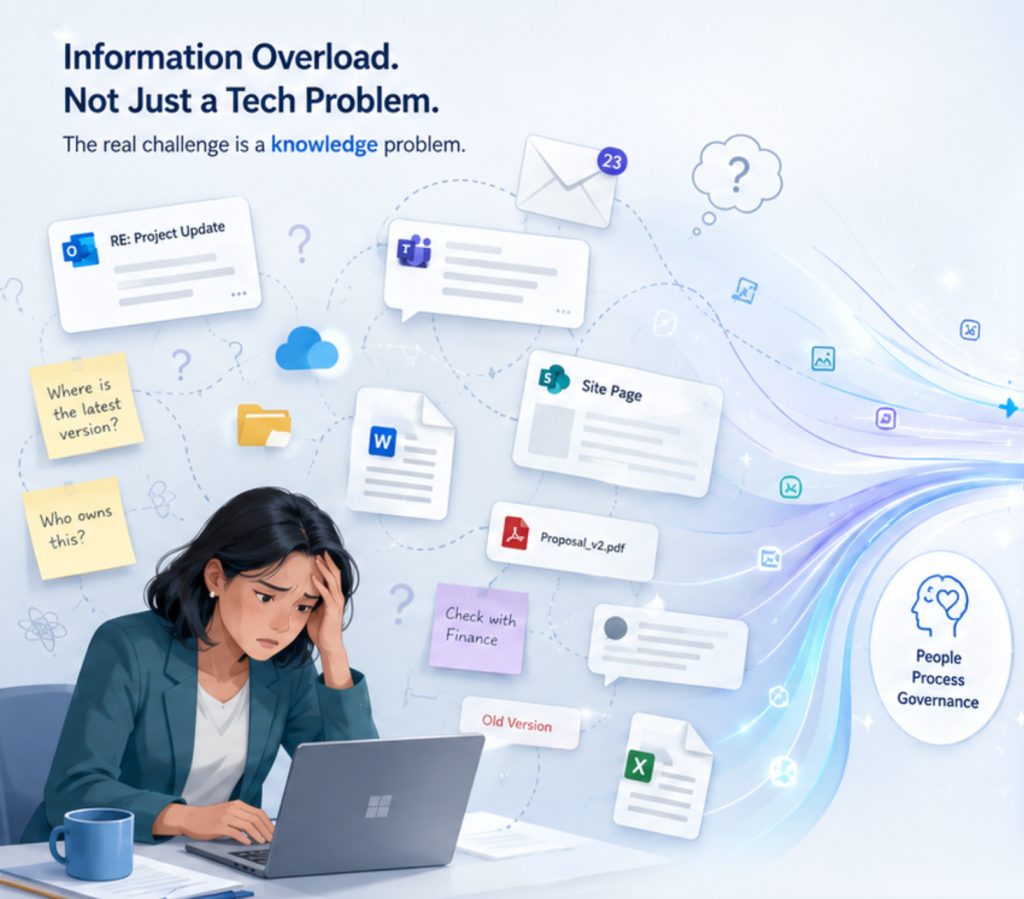
Most organisations don’t have a technology problem
What is a Microsoft 365 knowledge hub?
A Microsoft 365 knowledge hub is a governed entry point to trusted organisational knowledge, combining SharePoint sites, structured content, metadata, and search to help users find reliable information quickly.
A well-designed knowledge hub should help users answer:
- What is the approved way to do this?
- Which template should I use?
- Who owns this process?
- When was this last reviewed?
- Is this still current and trusted?
Why knowledge often exists but isn’t operationalised
- Lessons learned documents from projects
- One-off process guides
- Repeated answers in Teams chats
- “Tribal knowledge” held by experienced staff and senior leadership
- Templates stored in disconnected folders
The result looks like this:
- Multiple versions of the same process
- Documents with no clear owner
- Outdated content appearing in search
- Critical knowledge buried in Teams
- SharePoint sites with inconsistent structure
- Employees relying on “who knows what” instead of “where is the source of truth
- Copilot surfacing content that exists -but isn’t trustworthy
Microsoft’s own SharePoint information architecture guidance makes the same point from an architectural perspective: effective information architecture depends on how content is organised, labelled, navigated, searched and governed across the tenant. It is not only about creating sites; it is about helping users find what they need in a way that supports their work.
That is why I think the knowledge hub conversation matters so much now, especially with Microsoft 365 Copilot becoming part of the workplace.
Copilot does not magically fix poor knowledge management. In many cases, it exposes it.
A knowledge hub is not a document library
This is where organisations often go wrong.
When people hear the term “knowledge hub,” the first response is often: “Great, let’s create a SharePoint site and move documents into it.” That may be a useful first step, but it is not the solution on its own.
- Curated
- Governed
- Structured
- Maintained
- Trusted
The building blocks of a Microsoft 365 knowledge hub
A strong knowledge hub combines several layers:
Layer | Purpose |
SharePoint hub sites | Organise related knowledge areas and provide navigation, structure, and content roll-up |
Communication sites | Publish official, curated knowledge for broad audiences |
Team sites | Support working collaboration for teams and projects |
Metadata and content types | Make content findable, classifiable, and governable |
Microsoft Search | Help users discover content across the organization |
Microsoft Syntex | Automate classification, extraction, tagging, and document processing where appropriate |
Purview | Apply retention, sensitivity, compliance, and audit controls |
Copilot |
Why governance is critical for knowledge hubs
Governance must cover content quality. This is the part of governance that often receives too little attention.
In Microsoft 365, governance discussions often focus on permissions, external sharing, retention, sensitivity labels, lifecycle, and compliance. Those controls are essential, but a knowledge hub also needs governance for the quality of the knowledge itself.
- A document can be secure and still be useless.
- A page can be compliant and still be outdated.
- A process guide can be searchable and still be unclear.
- A Copilot answer can be permission-trimmed and still be grounded in poor content.
The real question, then, is how to ensure documented knowledge is good enough to be trusted. That requires a content quality model.
What are some of the basic standards for creating a good knowledge hub?
Every knowledge asset should meet minimum standards:
| Quality Area | What good looks like |
|---|---|
| Accuracy | Reflects current approved processes |
| Ownership | A named accountable owner |
| Currency | Defined review and expiry dates |
| Clarity | Written in plain language |
| Completeness | Actionable without extra conversations |
| Consistency | Standard structure and naming |
| Findability | Metadata supports search |
| Reusability | Can be reused across teams |
| Compliance | Correct controls applied |
| AI-readiness | Structured for Copilot and search |
How Microsoft 365 Copilot changes knowledge management
Copilot does not fix poor knowledge management. It exposes it.
- People worked around gaps by asking colleagues, reusing old files or recreating content
- Poor quality knowledge becomes visible at scale
- Duplicate policies
- Unclear ownership
- Outdated guidance
- Inconsistent metadata
How to build a knowledge hub
Small and mid-sized organisation should start practical
Not every organization needs a complex federated knowledge architecture from day one. For small to mid-sized organisations, start simple:
- Create a central SharePoint communication site for core organisational knowledge
- Structure content into policies, templates, procedures, FAQs and onboarding
- Use metadata (owner, business unit, content type, audience, review date)
- Configure Microsoft Search bookmarks and acronyms
- Introduce lightweight approval and publishing processes
- Use Power Apps or Lists for structured knowledge capture, such as lessons learned or skills registers
- Assign clear ownership for each knowledge area
Large enterprises should use a federated model
For larger organisations, a single central knowledge site rarely scales well. Different business units often have distinct processes, audiences, security requirements, and terminology, and forcing all knowledge into one place usually creates bottlenecks and weak adoption.
Large organisations need a hub-and-spoke model. In this approach, the central knowledge hub provides shared standards, navigation, governance, taxonomy, and enterprise-wide content, while business units maintain their own connected knowledge areas using the same metadata, publishing, and review model.
This federated model keeps knowledge close to the people who understand it, while still operating within a consistent enterprise framework. A typical division of responsibilities might look like this:
Area | Responsibility |
Central governance team | Defines taxonomy, templates, lifecycle, compliance, search standards, and quality model |
Business unit knowledge owners | Maintain local procedures, FAQs, templates, and business-specific guidance |
Content reviewers | Validate accuracy and approve updates |
Knowledge managers | Monitor quality, duplication, search behaviour, and user feedback |
IT / M365 admins | Configure SharePoint, search, Syntex, Purview, permissions, and lifecycle controls |
This model is also more resilient because knowledge is never static. Organisations restructure, processes change, employees leave, systems are replaced and regulations evolve. A knowledge hub therefore needs to be designed for change from the beginning.
Where Microsoft Syntex fits
This is where tools like Microsoft Syntex can add real value.
Syntex can support high-volume content processing, extract metadata, classify documents, and apply content understanding across SharePoint. Microsoft describes it as using AI and machine teaching to automate content processing and transform content into knowledge.
That is especially useful for organisations managing large volumes of documents that need classification, tagging, or extraction. Even so, Syntex should not be treated as a substitute for governance. It can assist with tasks such as:
- AI can help classify content.
- AI can suggest metadata.
- AI can extract values.
- AI can support document processing.
However, humans still need to define what “good” means. Someone still needs to decide:
- Which content types matter?
- Which metadata fields are mandatory?
- What qualifies as an authoritative source?
- What should be archived?
- What needs approval?
- What content can Copilot use?
- Which business area owns the knowledge?
- How often should it be reviewed?
This is why the future of knowledge management is best seen as a partnership between architecture, automation, and human accountability.
A practical framework for knowledge quality
For organisations starting this journey, a simple quality framework is often the best place to begin before migrating or creating too much content.
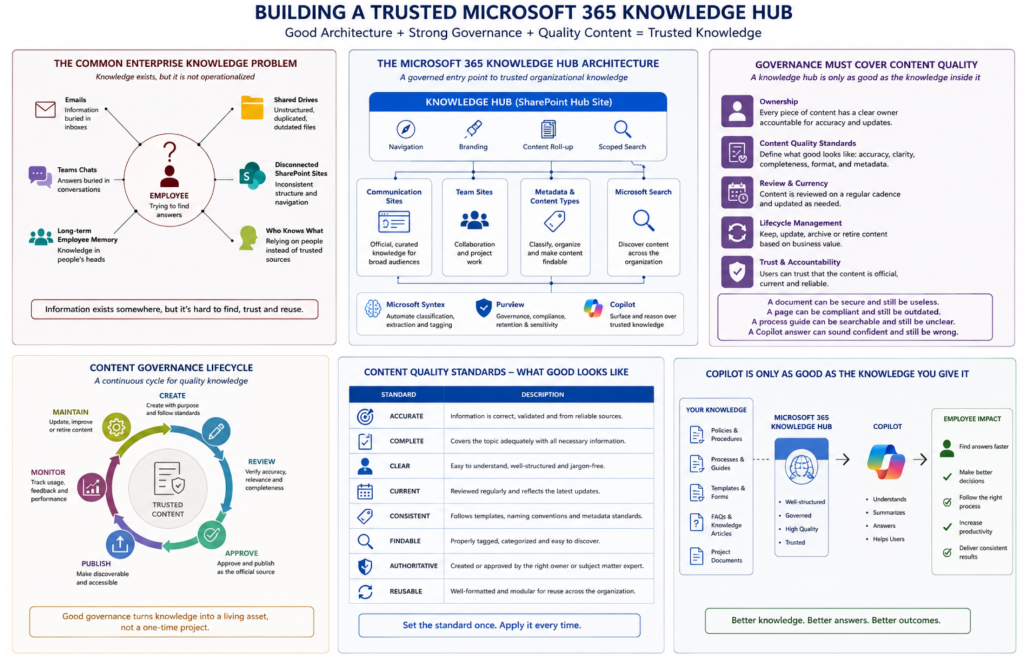
A practical framework can be built around five core elements:
1. Define knowledge categories
Category | Example |
Official policy | HR policies, security policies, compliance rules |
Process guidance | How-to guides, operational procedures |
Templates | Project templates, forms, client-facing documents |
Reference material | Glossaries, acronyms, system guides |
Lessons learned | Delivery retrospectives, project insights |
Community knowledge | Tips, FAQs, informal guidance |
Structured records | Registers, controlled lists, system-generated information |
Each category should have its own rules for ownership, approval, review, and retention.
2. Use consistent templates
Consistency improves both human usability and AI retrieval.
For example, a process guide should always include:
- Purpose
- Audience
- When to use it
- Prerequisites
- Step-by-step instructions
- Related systems
- Related documents
- Owner
- Last reviewed date
- Next review date
- Escalation contact
This may sound basic, but it can dramatically improve the quality and usability of documented knowledge.
3. Apply metadata intentionally
Metadata should not be added for its own sake.
It should support search, filtering, governance, lifecycle, and reporting. Useful metadata might include:
Useful metadata might include:
- Business unit
- Process area
- Content type
- Audience
- Owner
- Review date
- Sensitivity
- Status
- Source of truth
- Related system
- Region
- Applicable role
Metadata architecture is one of the core elements of SharePoint information architecture because it supports browsing, search, compliance, and retention outcomes.
4. Define lifecycle stages
Every knowledge item should have a lifecycle.
For example:
Stage | Description |
Draft | Content is being created |
In review | Content is awaiting validation |
Published | Content is approved and available |
Under review | Content has reached its review date |
Deprecated | Content is no longer current but retained temporarily |
Archived | Content is removed from active knowledge experiences |
Without lifecycle rules, knowledge hubs become digital museums: everything remains available, but nobody knows what is still true.
5. Measure quality over time
Knowledge quality should be measurable.
Useful metrics include:
- Percentage of content with an owner
- Percentage of content reviewed within the required timeframe
- Number of duplicate or near-duplicate documents
- Search queries with no useful result
- Most viewed knowledge pages
- Least used content
- Content with missing metadata
- Content flagged as outdated
- User feedback score
- Copilot or search-related failure themes
This is where governance becomes operational rather than theoretical.
Knowledge managers matter
One of the biggest mistakes organisations make is assuming knowledge management can be solved entirely through platforms. It cannot.
A good knowledge hub needs human roles. This does not always mean hiring a dedicated knowledge manager immediately, although larger enterprises may require that over time. It does, however, mean assigning accountability.
At minimum, each knowledge area should have:
- A business owner
- A content owner
- A reviewer or approver
- A technical owner for the platform configuration
- A governance owner for standards and lifecycle
My take: knowledge architecture is now AI architecture
This is the shift organisations now need to understand.
In the past, knowledge management was often framed as an intranet, document management, or employee experience problem. Now, with Copilot and AI agents becoming embedded across Microsoft 365 and Power Platform, knowledge architecture is increasingly part of AI architecture.
The quality of your SharePoint sites, metadata, permissions, content ownership, and lifecycle management directly affects how confidently AI can support your employees. If your knowledge is fragmented, duplicated, outdated, overshared, or undocumented, your AI experience will inherit those weaknesses.
The question is no longer just, “Where should we store our documents?”
A better question is how to create a trusted knowledge foundation that both people and AI can rely on safely. That is a much more strategic conversation.
Key takeaways
- A knowledge hub is only as good as its content
- Governance must include content quality – not just security
- Copilot amplifies both strengths and weaknesses
- Ownership and lifecycle management are critical
- Knowledge architecture is now AI architecture
Final thoughts
I appreciated Marcel Broschk’s framing of the knowledge hub problem because it reflects a reality many organisations are facing: knowledge is everywhere, but it is not always usable. Microsoft 365 provides the building blocks to address this through SharePoint, hub sites, Microsoft Search, Syntex, Purview, Copilot, and Power Platform.
But technology is only one side of the answer. The real success factor is the operating model around it.
A good knowledge hub needs:
- Clear architecture
- Strong governance
- Content ownership
- Quality standards
- Metadata discipline
- Review cycles
- Search optimization
- Human accountability
- Continuous improvement
At the end of the day, a knowledge hub is not valuable simply because it contains content. It is valuable because people trust what they find there, and in the age of Copilot, that trust matters more than ever.
Happy Reading!
Singing out,
Delaram