
TL;DR: Power Platform inventory gives tenant administrators a unified view of agents, apps, and flows across the organisation. That makes it far more than an admin convenience feature, it is becoming a practical governance and visibility capability that helps teams understand what exists, who owns it, and where risk or sprawl may be building as part of broader Power Platform inventory governance.
Table of Contents
A feature update with bigger governance implications
Power Platform inventory may be one of the most useful admin features Microsoft has introduced in a while. It is now generally available, and Microsoft describes it as giving tenant administrators a unified view of all agents, apps, and flows built on Power Platform across the organisation. Administrators can discover, search, filter, and sort those resources to streamline common administrative tasks.
That matters because most governance problems do not begin with malicious intent or dramatic platform failure. More often, they begin with poor visibility.
Teams cannot govern what they cannot see clearly, and in large estates that often means apps, automations, and agents spreading faster than admins can meaningfully track them. Microsoft’s own March 2026 feature update frames Power Platform inventory in exactly that context, highlighting unified visibility across cloud flows, Copilot Studio agent flows, and Workflows agent workflows across every environment.
So, this is the real question: is Power Platform inventory just another admin screen, or is it becoming a foundational governance capability?
I think it is the latter, and that is why this feature deserves far more attention than it is getting right now.
What Power Platform inventory actually does
To start with, Microsoft defines Power Platform inventory as a tenant-wide view of all agents, apps, and flows built on Power Platform. In practical terms, it gives administrators a single place to:
- discover resources
- search across resources
- sort and filter assets
- support common administrative tasks
- identify top creators
- improve operational awareness
That sounds simple, but it solves a very real problem.
In many organisations, Power Platform growth happens unevenly. One environment may be tightly governed, while another accumulates apps and flows quickly. One business unit may be highly mature, while another leans heavily on self-service creation without much structure.
Over time, visibility fragments. Admins stop seeing the estate as one platform and start seeing only isolated parts of it. Power Platform inventory is useful precisely because it starts pulling that picture back together.
Microsoft’s March 2026 update also notes that expansion with connectors, actions, and key usage data is on the way, with the stated goal of helping admins spot the most active automations, enforce compliance, and prevent orphaned resources. That is especially important because it moves inventory beyond a static list and closer to a practical governance tool.
Governance challenges
Most Power Platform admin challenges are not purely technical. They are governance challenges made harder by limited visibility.
For example:
- teams may not know which assets exist across the tenant
- ownership may be unclear
- unused or duplicated resources may go unnoticed
- high-risk environments may not stand out quickly enough
- admin effort may drift into manual investigation
This is exactly where inventory becomes more valuable than it first appears.
Why visibility matters
Visibility is foundational to scalable Power Platform governance.
If admins cannot reliably see what exists, where it lives, and who is responsible for it, then governance becomes reactive. By the time something looks risky, duplicated, abandoned, or non-compliant, the platform has already drifted.
Power Platform inventory helps reduce that drift by giving admins a more complete tenant-wide picture.
Inventory beyond the UI
This is also where the feature becomes more interesting from an architecture perspective.
Inventory is not just a user interface feature. Microsoft’s documentation and related references show that inventory data can also support deeper analysis patterns. That means it can become part of broader governance reporting, structured review processes, and operational visibility.
So while the UI matters, the more important point is this: inventory can help establish a more consistent admin rhythm around how the platform is growing.
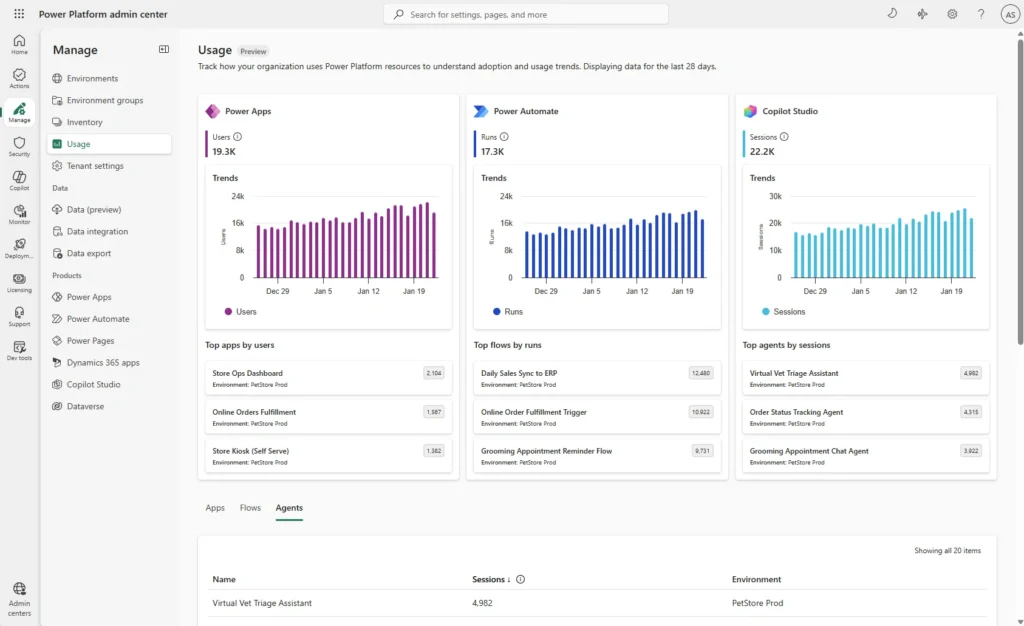
How Power Platform Inventory Improves Governance
“Power Platform inventory is a tenant-wide governance and visibility capability for discovering and managing Power Platform resources.”
That definition matters because inventory can sound like a basic catalogue feature when described too loosely. In reality, it is much more useful than that.
At first glance, inventory can sound like a basic catalogue feature. However, this is exactly the kind of capability that tends to matter more over time, not less.
Most Power Platform admin challenges are really visibility challenges in disguise:
- Which resources exist?
- Who owns them?
- Which environments are most active?
- Where are flows or agents accumulating?
- Which assets look abandoned, duplicated, or risky?
Without good inventory, those questions often turn into manual investigations.
With inventory, they become much easier to answer at platform level. Microsoft’s admin center overview reinforces that the Power Platform admin center is meant to be a unified portal for managing environments and settings across Power Apps, Power Automate, Power Pages, Copilot Studio, and some Dynamics 365 apps. Inventory fits naturally into that wider direction.
This is why I think Power Platform inventory is more important than it first sounds. It is not just about listing resources. It is about improving the starting point for nearly every governance conversation.
The real value: governance starts with visibility
Next, it helps to be blunt: governance rarely fails because organisations lack policies on paper. It fails because those policies are hard to apply consistently when the estate is not visible enough.
That is where inventory becomes genuinely useful.
Microsoft’s documentation says admins can use Power Platform inventory to discover resources and streamline administrative tasks. The associated schema reference and inventory API documentation go further, showing that inventory data is exposed through Azure Resource Graph and can be queried in structured ways. That means inventory is not just a passive UI feature.
It can also support deeper analysis, integration, and reporting patterns for teams that need more than a basic portal view.
This is where the feature gets more interesting from an architecture and operations perspective.
It can help support:
- tenant-wide reviews
- governance reporting
- orphaned resource discovery
- creator activity analysis
- cross-environment visibility
- targeted admin investigations
Once you think about it that way, inventory starts looking less like “nice to have” and more like a missing layer many organisations have needed for years.

Why Power Platform inventory matters now
Microsoft has made Power Platform inventory generally available in March 2026, and at the same time is signalling further expansion around connectors, actions, and usage data. That means the capability is arriving at the same moment Power Platform estates are becoming more complex, not simpler. Agents are increasing. AI-connected automation is increasing. Governance expectations are increasing. A tenant-wide resource view matters more in that environment than it would have a few years ago.
There is also a broader analytics angle. Microsoft already supports self-service export of Power Platform inventory and usage data into Azure Data Lake Storage for organisational reporting and retention needs. That means inventory does not have to remain trapped in a single admin view; it can feed wider reporting and governance patterns where needed.
So, taken together, the message is fairly clear: Microsoft is building inventory as part of a broader control and visibility story, not as a standalone curiosity.
What most teams will underestimate
Many organisations still underestimate how foundational visibility is to scalable Power Platform governance.
They will treat inventory as useful for cleanup, but not as a strategic capability. I think that is too narrow.
The real opportunity is not just finding what already exists. It is building a more reliable admin and governance rhythm around what is changing constantly.
Microsoft explicitly says Power Platform inventory gives tenant administrators a unified view across agents, apps, and flows, which means it sits right at the intersection of platform growth and platform control.
In other words, inventory helps answer a more important question than “what do we need to delete?”
It helps answer: what is actually happening in this platform, across this tenant, right now?
That is a much more valuable question.
A practical way to use Power Platform Admin Center
So, where should teams start?
A sensible first step would be to use inventory as part of a regular review cycle. For example:
- review resource growth across environments
- identify high-volume creators and support them intentionally
- look for potential orphaned flows or apps
- compare inventory patterns against existing governance assumptions
- use the API or analytics export if deeper reporting is needed
Microsoft’s own documentation supports several of those outcomes directly, especially around discovering resources, identifying top creators, and streamlining administrative tasks.
That is why this feature is worth watching closely. It can make governance more proactive, not just reactive.
Final thoughts
To bring this together, Power Platform inventory matters because governance begins with visibility. Microsoft now provides a unified tenant-wide inventory of agents, apps, and flows, and is already signalling more depth through connector, action, and usage expansion.
That may not sound as exciting as a new AI feature. But from an admin and architecture perspective, it could end up being more useful than many headline features because it helps teams understand the estate they are actually trying to govern.
And if you cannot see the platform clearly, you cannot really govern it well.
If you have not reviewed Power Platform inventory yet, now is a good time to start. Use it to validate your governance assumptions, identify where your estate is growing fastest, and decide whether inventory should become part of your regular admin review cycle.
If you would like to learn more about Arinco’s Power Platform services, visit our Biz Apps page.
Frequently asked questions
What is Power Platform inventory?
Power Platform inventory is a tenant-wide view of Power Platform agents, apps, and flows that helps administrators discover, search, filter, and manage resources across the organisation.
What can administrators see in Power Platform inventory?
Administrators can see agents, apps, and flows across the tenant. Microsoft also positions it as a way to identify top creators, review activity more easily, and support common administrative tasks.
Is Power Platform inventory generally available?
Yes. Microsoft announced that Power Platform inventory became generally available in March 2026.
How does Power Platform inventory improve governance?
It improves governance by increasing visibility. That helps administrators understand what exists, who may own it, where resources are accumulating, and where review or cleanup may be needed.
Can Power Platform inventory integrate with Azure Resource Graph?
Based on Microsoft’s inventory references and schema/API documentation, inventory data can be exposed through Azure Resource Graph for structured querying and deeper analysis.